
Bladen County Court Records After a Jail Arrest
Bladen County criminal court records are handled through the North Carolina Judicial Branch, not through a county jail roster. The Bladen County Courthouse is at 166 E. Broad St., Elizabethtown, NC 28337, and the courthouse page lists the main number as (910) 872-7200. The NC Judicial Branch Bladen County page places Bladen in Prosecutorial District 15, Superior Court District 15A, and District Court District 15. After an arrest and booking at the Bladen County Detention Center, the court record becomes the place to follow charges, hearing dates, bond conditions, filings, and final outcomes.
The arrest and jail record answer custody questions: whether the person was booked, whether the person remains in the Bladen County Detention Center, and how to reach visitation, mail, and bond channels. The court record answers different questions: what case was filed, what charges the prosecutor is pursuing, whether a charge has been amended or dismissed, when the next hearing is scheduled, and whether a conviction exists. For the custody side, use jail inmate records. For booking-photo questions, use jail mugshots.
How to Find Court Records After an Arrest in Bladen County
The main statewide online starting point is the NC eCourts Portal. The portal landing page exposes Smart Search, Search Hearings, Make Payments, NC Judgment Search, Register, and Sign In. Smart Search is the broad case-search route. Search Hearings is useful when the immediate need is a court date or hearing setting. The portal uses JavaScript and cookies, and anonymous access may require CAPTCHA checks.
- Open the NC eCourts Portal and choose Smart Search for case records or Search Hearings for hearing information.
- Search by defendant name or case number when known. If the arrest is very recent, also check the Bladen criminal calendar route and the clerk because the portal may lag.
- Open the case result and read the charge list, case number, hearing events, and status entries carefully.
- Compare each court charge to any jail booking charge. The wording may differ because prosecutors can amend, reduce, dismiss, add, or replace charges.
The project screenshot from the NC eCourts Portal shows the statewide landing page with Smart Search and Search Hearings options.
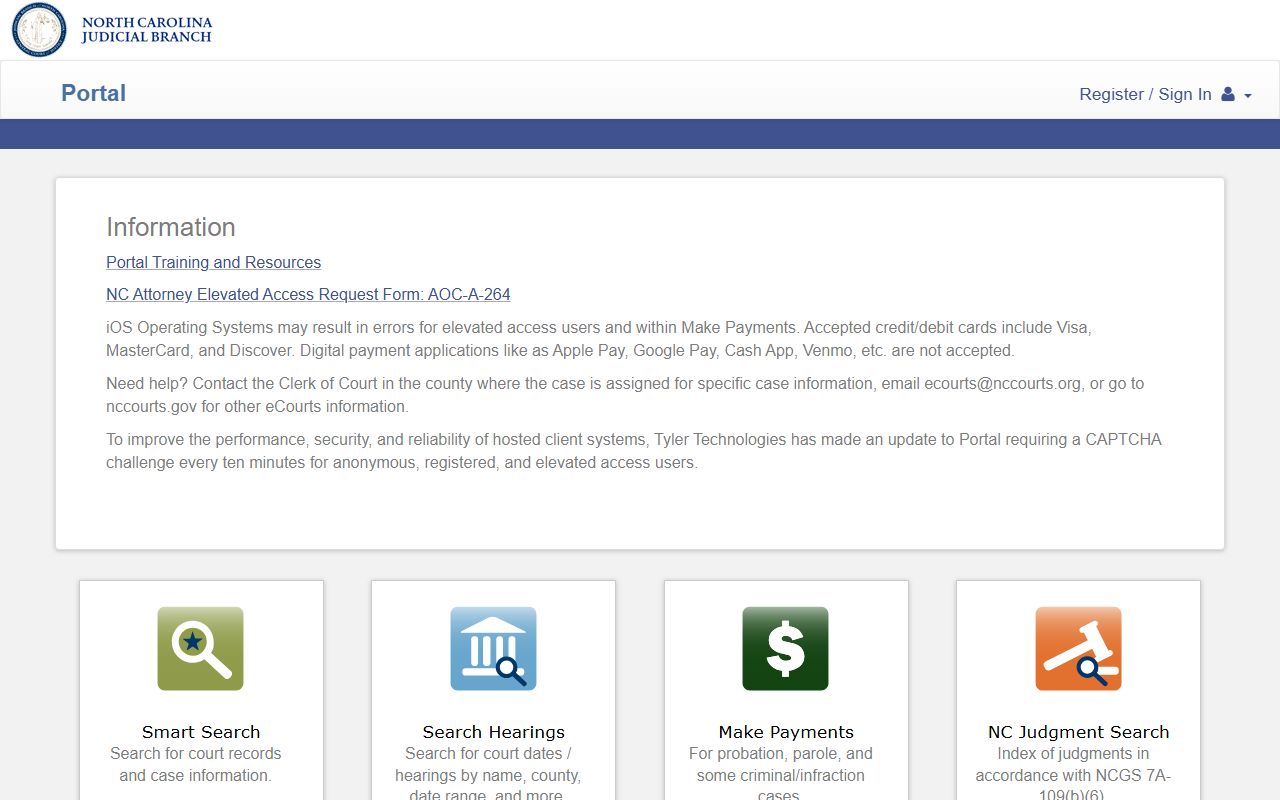
The portal image is useful because Bladen County criminal cases are searched through the statewide court system rather than a sheriff jail roster.
The NC Judicial Branch also provides a Bladen criminal calendars route. Calendar results are not a complete criminal-history report, but they are useful for upcoming criminal settings. For certified single-county criminal record searches, the Judicial Branch criminal-background-check page says requests go through the clerk using form AOC-CR-314 with a $25 fee.
Courthouse, Clerk, Magistrates, and District Attorney
The courthouse contact directory lists the Clerk of Superior Court at (910) 872-7200, District Attorney at (910) 872-7300, and Magistrates at (910) 872-7221. Magistrates are important shortly after arrest because they can issue process and address initial release conditions in many situations. The clerk is the record custodian for many court-file questions. The district attorney prosecutes criminal cases for the State; the DA does not serve as a defense lawyer, post bond, or run the county jail.
The official Conference of District Attorneys page identifies District Attorney Jon David for Prosecutorial District 15, serving Bladen, Brunswick, and Columbus counties. That office represents the State in criminal and juvenile matters and supervises prosecutorial staff. For a person trying to understand why a booking charge became a different court charge, the case record and court filings are more reliable than a jail intake summary.
Court Record Search Channels After a Bladen County Arrest
Different public tools answer different questions after an arrest. Using the wrong channel can make a valid case look missing. A person newly booked into the detention center may have a jail custody record before the court portal reflects every filing. A person with an older conviction may need a certified clerk search rather than a current hearing lookup.
| Need | Use | What It Shows |
|---|---|---|
| Case lookup after arrest | NC eCourts Portal Smart Search | Case records, parties, charges, events, and status entries when available. |
| Upcoming hearing | NC eCourts Portal Search Hearings or Bladen criminal calendars | Hearing settings, court dates, and calendar information. |
| Certified county criminal record | Clerk using AOC-CR-314 | Certified single-county criminal record search for a $25 fee. |
| Current custody or bond route | Bladen County Detention Center | Whether the person is in jail, intake status, release routing, and local holds. |
| Warrant or initial process question | Sheriff, magistrates, clerk, or counsel | Whether process exists, has been served, or led to a booking. |
Charging Documents After an Arrest
A jail arrest can begin with an officer's process, a warrant, an order for arrest, a citation, or another charging pathway. The court record becomes more important as the case moves from booking into formal prosecution. A charge listed at intake is an early snapshot. A charge in court is the filed allegation that the court tracks through hearings and disposition. In felony matters, indictments may later replace or refine earlier paperwork.
| Document or Process | Common Role | Why It Matters |
|---|---|---|
| Criminal process / warrant | Starts or supports arrest and court jurisdiction | May explain why the person was booked and what initial charge was served. |
| Citation or magistrate paperwork | Can start a misdemeanor or initial appearance pathway | May appear before later prosecutor action changes the case posture. |
| Indictment | Grand jury charging document for felony prosecution | May supersede earlier arrest wording or add more precise felony charges. |
| Information | Charging document in some criminal contexts | Use the case file to confirm how it applies in the specific North Carolina case. |
| Disposition entry | Final or current result for a charge | Shows whether the charge is pending, dismissed, amended, reduced, or resulted in conviction. |
Charge Status in Court Records After an Arrest
Charge status is where many Bladen County searches become confusing. A jail booking may list one arrest charge, while court records later show an amended count, a reduced count, a dismissed count, or an indictment with different wording. The court record should be read charge by charge because one case can have several outcomes at the same time.
| Status | What It Means | Search Note |
|---|---|---|
| Pending | The charge has been filed and has not reached final disposition. | Check hearings and bond conditions for next steps. |
| Amended | The charge wording or legal basis changed after filing. | Compare the newest court entry with the original jail booking language. |
| Reduced | The charge was lowered to a lesser offense. | The final record may not match the arrest label. |
| Dismissed | The prosecutor or court ended the charge without a conviction on that charge. | A dismissal is not the same thing as automatic expunction. |
| Nolle prosequi / voluntary dismissal | The prosecutor elected not to proceed. | Confirm the exact disposition language in the case file. |
| Conviction | A guilty plea, verdict, or other formal conviction result exists. | Use certified clerk records when an official copy is needed. |
Bond and Release Conditions After a Jail Arrest
North Carolina criminal-process materials explain that first appearance is an early hearing where a district court judge informs the defendant of the charges, ensures the defendant has the criminal process, reviews release eligibility, and addresses counsel and probable cause issues. Release conditions can include a written promise to appear, unsecured bond, custody release to a person or organization, or secured bond. A secured bond can involve cash, property, or a surety.
| Release Type | How It Works | Bladen Search Point |
|---|---|---|
| Written promise to appear | The defendant signs a promise to appear in court. | Confirm through court or detention center; not every charge qualifies. |
| Unsecured bond | No upfront deposit is paid, but the person may owe the amount if conditions are violated. | Often easier to verify through court records than a roster display. |
| Secured bond | Cash, property, or surety must secure release. | Call the jail or magistrate because sheriff pages do not publish payment rules. |
| Surety bond | An authorized bondsman or other surety guarantees appearance. | The NC Judicial Branch has a service for finding authorized bail bondsmen. |
| No-bond hold or detainer | Release is blocked until a judge or another agency changes the hold. | Federal, ICE, probation/parole, domestic violence, or other-county holds may affect release. |
Warrants and Court Records After a Bladen County Arrest
No official Bladen County public active-warrant search was located on the sheriff website. The sheriff app page lists Inmate Search, Inmate Info, Sex Offenders, Submit A Tip, Contact Us, and other features, but it does not list a warrant-search feature in the researched source. Warrant questions should be routed to the sheriff, magistrates, clerk, court records, or a lawyer rather than unofficial databases.
An arrest warrant, order for arrest, or bench warrant can lead to booking at the Bladen County Detention Center. Search warrants are different because they concern authority to search property or evidence, and returned search-warrant records may be sealed or limited. If an order for arrest came from a missed court date, the court calendar and case record usually matter as much as the jail custody record.
Charges vs. Convictions in Court Records After Arrest
A charge is an accusation in a court case. A conviction is a final result based on a guilty plea, verdict, or other qualifying disposition. A Bladen County arrest may create a public case record even when the person is later acquitted, the charge is dismissed, or the prosecutor chooses a different path. For employment, licensing, housing, immigration, or firearms consequences, the difference between a charge and a conviction can be critical.
| Feature | Charge | Conviction |
|---|---|---|
| Stage | Allegation after arrest or filing | Final guilty result or plea-based outcome |
| Proof | Lower early-case standards can apply | Criminal conviction standard or plea acceptance applies |
| Record Meaning | Does not prove guilt | Shows a formal guilty outcome unless later changed by court action |
| Where to Verify | Portal, calendars, clerk, case file | Certified clerk search or official court disposition |
Sealed vs. Expunged Court Records After an Arrest
Sealing and expunction are not the same as a dismissal entry. North Carolina court and NCSBI expunction resources describe expunction as a legal process to remove, seal, or destroy eligible records of an arrest, charge, or conviction. NCSBI says the process is initiated by filing the petition in the county where the arrest occurred. Eligibility depends on the specific case, disposition, prior record, waiting period, and statute.
| Feature | Sealed | Expunged |
|---|---|---|
| Public visibility | Hidden from ordinary public access by court order or law | Removed, sealed, or destroyed from covered government records as ordered |
| Agency access | Some official access may remain depending on the order | Limited official access may remain in specific legal situations |
| How it happens | Through a law or court action restricting access | Through an expunction petition and court order if eligible |
| Bladen filing point | Check the clerk or court order | Petition is filed in the county where the arrest occurred when eligible |
Certified Criminal Record Searches and Background Checks
The NC Judicial Branch criminal-background-check page says a certified single-county criminal record search is requested through the clerk's office at the courthouse with form AOC-CR-314 and a $25 fee. Mail submissions accept money order or certified check. In-person submissions accept credit card, cash, money order, or certified check. Public courthouse terminals may allow self-service non-certified searches without a search fee, though printing charges may apply.
Important: Public lookup information is not a consumer report and must not be used for FCRA-covered screening decisions.
Restricted Court Records After an Arrest in Bladen County
Not every record tied to an arrest is open in the same way. Juvenile matters, sealed records, expunged records, confidential victim information, medical information, and some security-sensitive records may be restricted. Law-enforcement criminal investigation records are also treated separately under North Carolina public records law. If the need is a court filing, ask the clerk or use the portal. If the need is a jail booking record or booking photograph, ask the sheriff. If the need is an investigative file, expect a different legal analysis and possible withholding or redaction.